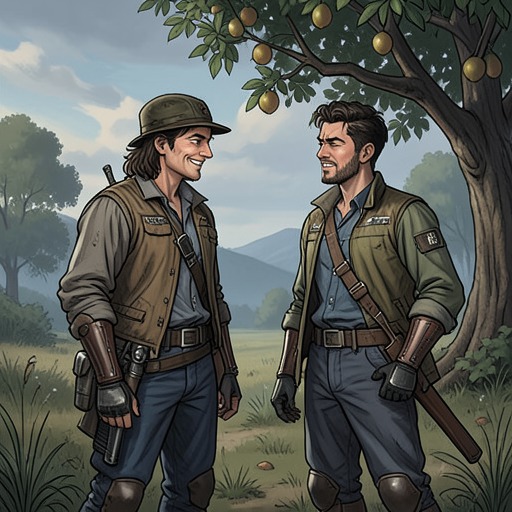
Talia and Lynch Become Mates and Complete the Transformation
Of Fates & Fables (The Complete Series)Talia and Lynch Become Mates and Complete the Transformation is a decisive convergence of love, bodily danger, and chosen allegiance. With Romy facing an urgent transformation and unwilling to endure it alone, Talia demands that Lynch bite her as well. What begins as an emergency act of solidarity becomes a confession, a freely made choice about the shape of her future, and the foundation of a formal bond between Talia and Lynch. The event changes Talia from Romy’s human friend and defender into a transformed member of the werewolf community, while making Lynch’s private love publicly consequential.
Crisis and the Choice to Stand Together
The immediate pressure comes from Romy’s impending transformation. Talia refuses to let Romy bear the physical and emotional ordeal without her, presenting companionship not as a comforting promise but as a practical risk she is prepared to share. She tells Lynch that she will not let Romy go through the experience alone and frames that decision through her responsibility as a beta. Her demand places loyalty above safety and turns friendship into an active form of protection.
Lynch initially resists because he understands that his bite would not be a neutral medical intervention. He explains that biting Talia would mean something different to him than it would to her: it would make her his mate. The danger therefore has two dimensions. Talia faces pain and irreversible transformation, while Lynch faces the emotional and social consequences of binding the woman he loves to him. His reluctance is not indifference but a recognition that the act carries a commitment Talia may not yet be ready to accept.
Confession and Mate Bond
The impasse breaks when Lynch states his love directly. He tells Talia that he loves her and describes their attachment through the comic image that she is like bacon because she makes everything better. His humor does not diminish the confession; it gives his fear and tenderness a form consistent with the irreverent intimacy between them. He also admits that he did not fall for her so much as trip over the relationship, an image that makes their romance sound accidental while confirming how completely it has taken hold.
Talia answers in the same playful register but with equal seriousness. She calls Lynch a big idiot, acknowledges that she is difficult, and turns that difficulty into a joke about his having two hands. Her declaration that she loves him with all her butt deliberately replaces conventional romantic language with a private idiom, yet its emotional force is unmistakable. The exchange transforms the bite from an act Lynch fears imposing on her into a commitment both characters have verbally recognized.
Birdie then proposes that the transformation formally make the two women their mates. In this setting, romantic attachment is not merely private feeling: it can be ratified through supernatural and communal structures. The scene therefore moves from confession to ceremony, from personal speech to a new social identity. Talia and Lynch’s bond is established alongside Romy and Kash’s relationship, linking the two couples within the same network of protection and future-making.
Talia’s Rejection of the Old Life
Before the transformation begins, Kash gives Talia an opportunity to reconsider. He asks whether she is certain and raises the family and post-college life she had previously planned. The question makes the cost of the decision explicit: Talia is not simply accepting a new body but abandoning a future organized around human institutions and expectations.
Her answer is unequivocal. She says that the life once imagined for her was never truly hers and that it is time to make her own choices. She chooses Romy and Lynch, always. This is the event’s central act of agency. Talia does not present transformation as something done to her by circumstance, romance, or pack authority; she claims it as a decision that expresses who she has become and whom she regards as family.
Kash’s care is also significant. Although he expects Talia to remain firm, he offers her one last way out rather than treating her choice as automatic. His caution distinguishes protective authority from coercion. The transformation is dangerous and unusual, and Kash warns her that it will hurt, but the decision remains Talia’s.
The Transformation and Its Immediate Aftermath
The procedure is painful and intimate. Kash performs the bite on Romy while Talia remains part of the same urgent process, and his warning makes clear that this is not the ordinary way such a change is carried out. The event’s physical intensity is inseparable from its emotional stakes: transformation is not an abstract change of species but an ordeal carried through the body, under time pressure, with loved ones close enough to witness and support it.
Lynch’s earlier refusal gives the eventual bite its full meaning. Once he accepts Talia’s decision, he is no longer merely the reluctant protector who fears changing her before she is ready. He becomes the person whose love and body complete her passage into the werewolf world. The transformation consequently joins the values of survival and intimacy: Talia gains the means to remain with Romy through the crisis, while Lynch receives the mate bond he had been afraid to initiate.
The event also redefines Talia’s relationship with Romy. Her choice is explicitly made for Romy as well as for Lynch, and the two friends enter transformation together rather than as isolated victims of supernatural violence. That shared passage contrasts sharply with the coercive conditions created by Brody, whose threats involve forced change, captivity, and control. Talia’s transformation is painful, but it is chosen, witnessed, and embedded in reciprocal care.
Consequences and Lasting Significance
The immediate consequence is the creation of two linked couples and a stronger chosen family. Birdie’s intervention places Talia and Lynch within the same future-facing structure as Romy and Kash, while Talia’s decision gives the group another transformed protector who understands the cost of standing beside Romy. The event turns friendship, romantic love, and pack belonging into mutually reinforcing forms of security.
Its later effects appear in the communal ending. Talia and Lynch ultimately recite vows with Romy and Kash, and the four claim their happily-ever-afters together beneath a blue moon, with their family surrounding them. The wedding scene confirms that the emergency transformation was not a temporary sacrifice made only to survive a single crisis. It became the beginning of a lasting identity and relationship.
The event’s symbolism is reinforced by the group’s later matching tattoos. Talia and Romy receive versions of the same design, with magic imbued into theirs, and Birdie’s ink functions as a magical form of connection and locating. Talia jokes about an alpha-beta handshake, but the tattoo makes the underlying reality clear: the women’s bond is now materially and magically marked. The transformation therefore culminates not in the loss of Talia’s individuality but in her deliberate entrance into a network she has chosen.
As a narrative event, the scene combines the transformation and love plots with rescue and survival. It reverses the meaning of bodily change established by Brody’s threats: where Brody uses transformation as punishment and domination, Talia accepts it as solidarity, self-determination, and access to a chosen future. The pain remains real, but the surrounding consent, confession, witness, and continuing care convert it from an instrument of possession into a passage toward belonging.